Showing posts with label Antioch. Show all posts

Monday, June 18, 2012

EARLY CHRISTIAN SYMBOLS — THE IKTHUS, or FISH


Hello My Friend and Welcome.

One of the earliest, and most common, symbols used by the Christians was the Ikthus, or Fish. We see used it today in its plainest form, two swooping lines, and in more elaborate forms with the inclusion of a small cross, the word JESUS, or the Greek ΙΧΘΥΣ within the classic fish shape. There’s more than one reason the Early Christians chose the symbol of a fish.

FISHERS OF MEN
The use of the fish symbol reminds one of the familiar scene in Matthew 4:18-20, Mark 1:17 and Luke 5:2-11. In all of these passages, Jesus, who has returned from his 40 days of preparation in the desert, begins to gather his first disciples. While walking along the shores of the Sea of Galilee, or Lake Gennesaret as the Jews called it, Jesus encounters Simon and his brother, Andrew and invites them to become his followers with enigmatic phrase, “Follow me, and I will make you fishers of men.”
Luke elaborates on the scene a bit and places the men in their boat after a night of luckless fishing. Jesus tells them to put down their nets for a catch, they do, and the nets fill to the point of bursting. True to form, Simon’s responds by saying, “Depart from me, for I am a sinful man, O Lord.”

THE ACROSTIC OF THE FISH
An acrostic is a word or phrase in which each letter stands for a word. We’ve all heard the song that spells mother by starting with, “M is for many things she gave me…” Acrostics are closely related to acronyms, which are an abbreviation formed from the initial components of a word or phrase…for instance, OPEC (Organization of Petroleum Exporting Countries) NATO (North Atlantic Treaty Association), the dreaded FAQ (Frequently Asked Questions) and so on. There’s probably a vacation travel game lurking in our penchant for acronyms. It surely beats license plate bingo, but we digress.

The Greek word for fish is IKTHUS, spelled ΙΧΘΥΣ. Using those five letters, we can develop a phrase in the following way:
With the Iota, we create the word Ιησονς…Iesous.
Using the next letter, Chi, yields the word Χριστος…Christos.
The Theta yields Θεος, Theos…God.
With the Tau, we make Υιος, Uihos…Son.
And the Sigma, gives us Σωτηρ, SoterSavior.
As the song says, put them altogether and you get Iesous the Christos, God’s Son and our Savior.

A MEANS OF COMMUNICATION
The simple image of the fish, or ikthus, became a means of identification for members of what the Romans considered a subversive cult. We find this simple symbol so rich in meaning scattered throughout the earliest examples of Christian art.

An Ancient Grave Carving Using the FISH

No one knows for sure who created it or when. However, the Acts of the Apostles tells us that it was in Antioch that the believers were first called Christians. Antioch was a thoroughly Greek city and former capitol of the Seleucid Empire. In the First Century it quickly became a leading center of the Early Church. It was the place from which Paul, Barnabas, John Mark, Silvanus and others left on their earliest missionary journeys. It was also the place to which they returned to rest, re-energize, and prepare for the next trip.
This coupled with the fact that the fish relies upon a Greek spelling of the word to convey its message, tends to lead one to the assumption that it, like the word Christian, originated in or around Antioch of Syria. Think about that the next time you see the symbol on the back of someone’s car.

Until next time, we wish you Peace and Blessings.

If you reached this post via a link, click the HOME tab above to see other recent posts and visit our archives.

Wednesday, June 6, 2012

PAUL, THE TENTMAKER FROM TARSUS

Rows of Black Tents Create a Nomadic Village in the Negev

Hello My Friend and Welcome.

ANTIOCH AND PAUL the APOSTLE
Saul, renamed Paul, spent a considerable amount of time working in the Church at Antioch. He also visited Antioch while on his missionary journeys. Sound contradictory? It isn’t. In those days, there were a number of greater and lesser Antiochs scattered about Asia Minor…all named in honor of Antiochus, father of Seleucus who founded the Seleucid Empire. Te most important of these was Antioch on the Orentes, the Western capitol of the Seleucid Empire, the seat of the Roman Province Syria and the third largest city in the Roman Empire, after Rome and Alexandria.

Christianity came to Antioch early. Believers began leaving Jerusalem following the persecution which resulted in Stephen’s death. The new faith was preached to and accepted by the Greeks of the city and it was in Antioch that the name Christian, or Christianos, originated. Antioch served as a base for the missionary journeys of Paul, Barnabus, Silas and others. The Church at Antioch played a preeminent role in the First and Second Century, especially after 70 AD when the Romans destroyed Jerusalem.

A TENTMAKER FROM TARSUS
One of the things we know about Saul/Paul is that he was a Jewish tentmaker from Tarsus in Cilicia. Cilicia was part of the larger area known to the Romans as Asia Minor in what is now southern Turkey. Its western boundary was the Taurus mountain range, a generally inaccessible area. A mountain pass, known as the Cilician Gate provided a way through the mountains to Cappadocia. The eastern half of Cilicia consisted of broad, fertile plains. Tarsus lay a short distance inland from the Mediterranean Sea astride the road leading to the Cilician Gate. It probably saw a lot of traffic as trading caravans and other merchants transported goods between the port and Cappadocia.

PAUL IN ANTIOCH
We know from the epistles that Paul took great pride in being self-supporting. This would imply that he practiced his trade both at home and away. By home we, of course, mean Antioch, which was the closest thing Paul had to a permanent residence after his conversion to Christianity.

How much time did he actually spend there? Acts 11 tells us that after Barnabus returned from Tarsus with Paul, they spent a year in the city preaching and teaching. They then took famine relief to Jerusalem and returned with John Mark. There appears to be an unspecified period of time prior to their leaving on the first missionary journey. 

Paul and Barnabus were gone two years. Then they returned and stayed in Antioch for between two and three years…autumn of 46 – 49 AD. Acts 14 They left for the Council of Jerusalem and, as soon as they got back, began preparing for the second missionary journey, which began about 50 AD. We know from Acts that Paul refused to all John Mark accompany them on the second mission. John Mark was Barnabas’s cousin, and this decision created a rift between the two men. Paul took Silvanus (Silas) instead and Barnabas and John Mark went to Cyrpus, which was Barnabas’ home.

Paul returned two years later for a period of R & R that lasted another year, and then set off on his third missionary journey. He never returned to Antioch. Instead, he sailed to the Judean capitol of Caesarea at the end of his third mission, was arrested in Jerusalem, and subsequently taken to Rome. Still, from the narrative above, we can easily credit Paul with between six and seven years in Antioch during which time he would have supported himself by making tents.

TENTMAKER, TENTMAKER, MAKE ME A TENT
Tents of that era were quite different from the quick up/quick down Coleman variety with adjustable aluminum poles, zippered flap and windows, and sewn-in floor. The tents of Paul’s day had no floor. The sides consisted of curtains that hung to the ground. They could be rolled back to admit the breeze during the day and pulled down to completely enclose the tent at night.

Close-up of the Finished Tent Cloth
New tents were typically only made when a young groom and his bride set up housekeeping for themselves. The tents consisted of long strips of fabric about three feet wide. These strips were sewn together to make any and all sizes of tents. The tent was regularly inspected and worn or ripped sections were removed and a new one sewn in its place. The piece they removed could be cut down and used for a side curtain. If the family grew and more space was required, additional strips were added to make the tent deeper or wider as necessary. Isaiah referred to this practice when he wrote, “Enlarge the place of your tent, and let the curtains of your habitations be stretched out; hold not back, lengthen your cords and strengthen your stakes.” (Isaiah 54:2)

These strips of tent cloth were woven on a simple horizontal loom. Some of these looms required the weaver to sit or kneel on the floor as they worked. Since Paul spent long hours at the loom, he most probably used a model that provided a seat. The illustration below shows a man in Senegal using a loom similar to one that Paul most likely used. The frame is set up at the proper width of the fabric. A roller near the user’s knees accumulates the finished fabric. The incoming threads are secured to a roller far in front of the loom.


A double harness loom is most efficient when weaving a single colored fabric. Weaving consists of passing a single weft thread back and forth between multiple warp threads. The warp threads are long and close, forming the body of the fabric. Their overall width determines the width of the finished piece and the finished piece can be no longer that the warp threads. The weft thread is wound on a spool, known as a shuttle. It binds the opposing warp threads together as it is passed back and forth. In order to weave, individual warp threads must be separated (lifted) from their neighbors. Odd numbered threads are attached to one harness and even to the other. When one pedal is depressed, half of the threads rise allowing the shuttle to pass between the threads.  When the other is depressed, the opposite threads rise for the shuttle’s return pass.

USING BLACK GOATS
The tent fabric was woven from black goat hair. This resulting fabric was coarse and heavy, providing protection during the cold months and at night. The goat hair cloth used for tents remained porous when dry. This facilitated airflow and dissipated heat in a desert-like environment. During periods of higher moisture —heavy dew or winter rains— the thread quickly swelled, making the tent waterproof. Solomon referenced the color of the tents when he wrote, “I am very dark, but comely, O daughters of Jerusalem, like the tents of Kedar…” (Song of Solomon 1:5)

Antioch lay between the road running from Boerea, known as the Silk Road, to the port of Pieria Seleucia. Caravans from as far away as China and India must have passed through the city on a regular basis. These merchants all lived in tents while on the move. Antioch was surely as good a location for a tentmaker as he could hope to find.

 Next time we’ll be examining the First Century game the Romans called Tabula.

 Until then, we wish you Peace and Blessings.

If you reached this post via a link, click the HOME tab above to see other recent posts and visit our archives.
Wednesday, January 25, 2012

VISITING THE CAVE CHURCH IN ANTIOCH

Exterior of the Cave Church or St Peter's Grotto
Hello My Friend and Welcome.

If you’re a frequent visitor, you’ve probably grown familiar with the cave-like image in our masthead. What you may not know is that the photo in the upper left of your screen is from the Cave Church, or St. Peter’s Grotto in Antioch (now Antakya). It is believed to have been dug out by St. Peter himself and used as a place of worship by the early Christian community in Antioch. This would make it the very first Christian Church ever built.

ANTIOCH: AN EARLY CENTER OF CHRISTIANITY
Antioch, of course, became the primary center of the early church after the Christians were dispersed from Jerusalem by persecution. Connected by the Orentes River to the Mediterranean port of Pieria Seleucia, it quickly became a major center of planning and organization the missionary efforts throughout Asia Minor and beyond. Luke, the Evangelist, was a native of Antioch and Peter, Paul, Barnabus and others used it as both a jumping off place and a safe haven to which they could return between journeys.

Inside: The Altar

The interior of the grotto is austere. Its few permanent items consist of a simple altar, a single statue, and a stone chair or seat. Deposits from years of seepage can be seen on the wall behind the altar. Some of the walls have the barely discernible remnants of ancient frescoes and the floor indicates traces of mosaics. Despite its simplicity, one can’t look at the photo of the interior without being awed by the holiness it exudes.

RESCUED BY THE CRUSADERS
The exterior stone façade of the church was built by Crusaders who identified the grotto during their rule of Antioch from 1098 to 1268. There is a tunnel in the back that leads into the mountain’s interior. It is believed to have been used as a place of hiding during times of persecution.
As we learned in last week’s post, Antioch has experienced many severe earthquakes over the centuries and the Turkish Government now restricts access to the Grotto Church because of seismic instability.

The Bapistry: A Natural Indentation Gathered Water from a Spring
A scene dealing with the development of the Cave Church by the new Christians appears in my novel, Disciple. For those who are interested, I’ve posted a short excerpt. Click HERE to read it.
The Side Exit Where Christians are Believed to Have Escaped
Next time, we will take a trip to Wadi Sikait, Rome’s Emerald City.

Until then, we wish you Peace and Blessings.
If you reached this post via a link, click the HOME tab above to see other recent posts and visit our archives.

Monday, January 23, 2012

THE ANTIOCH EARTHQUAKE THAT DESTROYED THE QUEEN OF THE EAST

Ruins of Ampitheatre in Antioch

Hello My Friend and Welcome.

Today we’re going to visit the ancient city of Antioch on the Orentes. In the First Century Roman world Antioch, with a population of more than half a million, was justifiably famous for its beauty, a leader in trade and culture as well as an important military outpost. Antioch rivaled Alexandria, the second city of the Roman Empire. Today, Rome, Italy has a population of 3.7 million and 4.1 million people call Alexandria, Egypt home.  Meanwhile Antakya, Turkey, once the seat of the Christian Church, has a population of only 140,000. Why? 

ANTIOCH’S HISTORY
Antioch on the Orontes, also known as Antioch of Syria, was situated on the eastern side of the Orontes River in the far southeastern corner of Asia Minor. When the city was founded in 300 BC by Seleucus I Nicator, he urged Jews to move there from Jerusalem. The city quickly developed a large Jewish population. As was his policy in all the cities he founded, Seleucus I granted these Jews equal rights of citizenship along with the Macedonians and the Greeks. Several ancient sources tell us that the Antiochene Jews, having a governor of their own and comprising a large percentage of the population, exerted as great an influence there as they did in Alexandria.  

Christianity came to Antioch following the persecution that resulted in Stephen’s death. The new faith was preached to and accepted by the Greeks of the city and it was there that the name Christian originated. The Church exhibited great enthusiasm and became the base of the missionary journeys of Paul, Barnabus, Silas and others.

Entance to the Temple of Aphrodite

Just as Ephesus gloried in the Temple of Artemis, Antioch was home to the main Temple of Aphrodite…the Aphrodisias. Interestingly enough, though typically associated with seduction and sexuality, the statue of Aphrodite was clothed in a heavy cloak that disguised her figure and a long veil covered her face. So much for the images of gauzy lingerie Aphrodite’s name conjures up.  

Remains of Church of St. Simeon

CHURCH OF ST. SIMEON
The city was also famous for the Church of St. Simeon, a native saint who lived in the Fifth Century. It consisted of four basilicas radiating from the sides of a central octagon. With over 16,000 square feet of floor space, it nearly equaled the more famous Hagia Sophia in Constantinople. The church was only one part of a huge, walled complex that included a monastery, two lesser churches, and several large hostels.


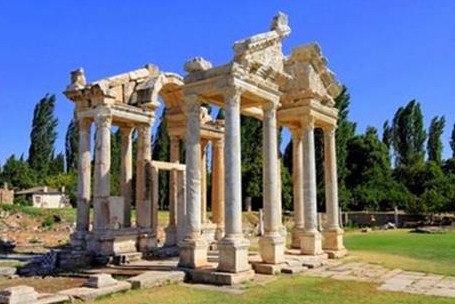
The Tetrapylon, or Monumental Gate
Antioch was also known for the Tetrapylon, or monumental gate. The ancient Greeks placed great importance on the location and orientation of architecture. Thus the main axis of the city was aligned with the distant mountains and the Tetrapylon was at one end of this axis. The city also had a large theater/stadium and the Museion, a complex on the island between the arms of the Orentes River devoted to the arts.  

THE QUEEN OF THE EAST MEETS A DISASTROUS END
True many of Antioch’s architectural treasures now stand in ruins, but even in their current state their former grandeur is readily apparent. So why did Rome and Alexandria prosper while Antioch languished? The answer to that question can be found in a single event that occurred in the year 526. 

Late in May of that year, sometime between the 20th and the 29th, a major earthquake struck Antioch and the surrounding area. On the Modified Mercalli Scale, it is estimated to have registered VIII (Destructive) at Antioch, the epicenter, and VII (Very Strong) at Daphne and Seleucia Pieria. The port of Seleucia Pieria experienced an uplift of between two to three feet. The subsequent silting up of the harbor left it unusable. The raging fire which followed destroyed any buildings in Antioch that survived the earthquake. In all, approximately 250,000 people died. It still ranks as the 3rd most deadly earthquake of all time.   

Given the extent of the damage and the area’s known seismic instability, the decision was made to abandon the city rather than attempt to rebuild. What a sad end for Antioch, the Queen of the East. 

Next time we’ll be examining another Antioch landmark. Known as the Cave Church, its image graces the header on the Sowing the Seeds Blog. It is considered to be the oldest Christian Church in the world. 

Until then, we wish you Peace and Blessings. 

If you reached this post via a link, click the HOME tab above to see other posts and our archives.