
Showing posts with label First Century Life. Show all posts

Tuesday, July 17, 2012

DID JESUS WEAR A TOGA?


Hello My Friend and Welcome. 

Do inaccuracies in fiction bother you as much as they bother me? For the fictive dream to become reality, the reader/viewer must relinquish control to the author, entering their world and experiences.  This entails the tacit agreement that the author will not play fast and loose with facts and emotions.  When non-congruous facts and details enter the narrative, they diminish the author’s credibility and destroy the fictive dream.  

A NAIL SALON ON A DESERT ISLAND?
For example, last night I watched a TV show in which a woman, who was supposedly marooned on a desert island, lost her wedding band. Earlier, she’d had been digging in the sand with her hands and when she returned to the spot her ring was there in the hole. This is when everything went awry. She reached into the hole, picked up the ring and put it back on. In so doing, she held her hand up to the light. Her long, neatly manicured fingernails were clearly visible. This was only the first of many inconsistencies and impossibilities.  

There are several things that could be going on here. A. The writer didn’t know and never bothered to find out, B. The director either didn’t care about accuracy or also didn’t know, or C. They assumed the viewer is too stupid to notice. But at least some of us do.

THE MOST COMMON MISTAKE
One of the most common misrepresentations of ancient dress is the toga. It becomes almost a cliché — ancient times, everyone wears togas. Not true. 

The toga, which most everyone has seen in movies and paintings, began as a simple wool wrap that was thrown on like a cape when going out in cool weather. From there, it grew and grew, becoming longer and longer and less and less practical. This distinctive Roman garment eventually became a twenty feet long piece of woolen cloth which was wrapped around the body over a linen tunic. The first togas were unisex garments, but that all changed around the second century BC. After that, the toga became exclusively a man’s garment and women were expected to wear the stola, a long, loose tunic.

A number of rules evolved regarding togas. For instance, only Roman citizens were allowed to wear them. The toga was considered the only decent attire when out-of-doors. Harkening back to their more humble origins, they were typically taken off indoors. They were also removed when performing physical labor. This is evident from the story of the Roman General, Cincinnatus, who was plowing his field when the messengers of the Senate arrived to tell him he had been made dictator. On seeing them approach, he sent his wife in to fetch his toga from the house so that he could be properly attired to receive them.

EVOLUTION OF THE TOGA
The toga gradually gained increased importance as a ceremonial garment and came to signify different stations within society. As early as the second century BC the toga became the characteristic badge of Roman citizenship. It was worn by magistrates on all occasions as a badge of office. It would have been highly improper for a magistrate to appear in any other attire.  

Augustus grew so upset when he observed a meeting of citizens without togas that he quoted Virgil's phrase, “Romanos, rerum dominos, gentemque togatam” —Romans, lords of the world, the toga-wearing race — when giving the order that no one was to appear in the Forum or Circus without it. 

Formal occasions demanded a plain white toga for Roman men of legal age. The first wearing of this toga virilis, also known as a toga alba or toga pura, became part of a boy’s maturation celebrations. There was also the toga candida a toga bleached to a dazzling white and worn by candidates for public office. Our term, candidate, was derived from the word candida, Latin for bright white; hardly appropriate in today’s political climate. During the Imperial period, the right to a wear the toga praetexta, an ordinary white toga with a broad purple stripe on its border, signified the honor of high rank.  

There was also the toga pulla, or dark toga. It was worn mainly by mourners, but could also be worn in times of private danger or public anxiety. It could also be used as a protest. For instance, when Cicero was exiled, the Senate resolved to wear togae pullae to protest his banishment.

Most elaborate of all was the toga picta a solid purple garment, embroidered with gold. Magistrates giving public games wore them, as did consuls and the emperor on special occasions. 

WHAT ABOUT JESUS?
Many, if not most, of the paintings of Christ and his disciples depict them wearing one form or another of what appears to be a toga. Is this portrayal accurate, possible, reasonable? No, of course not. They were Jews who would have most likely rejected all aspects of the Roman culture. They wore an ankle length tunic accompanied by a long-sleeved robe, or cloak, when needed for warmth.
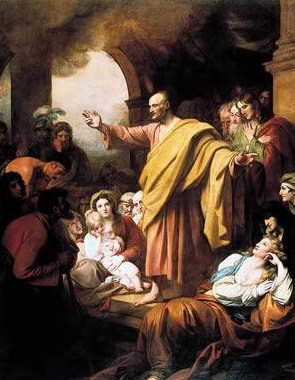
Of all the apostles, only Paul of Tarsus was a Roman citizen and therefore entitled to wear a toga. He very well may have worn one on his missionary journeys to enhance his credibility in cities such as Athens or Corinth. Whether he did or not, of course, we can never know. What we can know is that, even in Rome, Peter never wore a toga. He was forbidden to by Roman law. 

On Friday we’ll be adding our link to the Christian Writers Blog Chain. Until then, we wish you Peace and Blessings. 

If you reached this post via a link, click the HOME tab above to see other recent posts and visit our archives.

Monday, June 25, 2012

COSMETICS IN THE FIRST CENTURY

An Ancient Cosmetic Case
Hello My Friend and Welcome. 

“What has been is what will be, and what has been done is what will be done; and there is nothing new under the sun.”  — Ecclesiastes 1:9 

UNCHANGING HUMAN NATURE
We can summarize the words of Solomon above in the simple conclusion that human nature has pretty much stayed the same over time. Men are men, and women are women. This is nowhere truer than in the realm of cosmetics and make-up. Cosmetics are, and were, used by women at all levels of society. Women in ancient times manicured their nails, tweezed superfluous hair, and outlined their eyes in colors including black, green, aqua, terracotta and charcoal.  

Apparently humankind’s use of cosmetics dates to pre-historic times. Neolithic burials used red ochre pigments symbolically, either to represent a return to the earth or possibly as a form of ritual rebirth, in which the color symbolized blood and the Great Goddess. About twenty years ago an exhibit related to bathing and the use of beautifying compounds in the ancient Roman Empire was held in Paris. Called The Bath and The Mirror, one of its most interesting sections contained information about 144 different powders, unguents, and other cosmetic materials that had been excavated from various sites, many reconstituted and displayed in recovered glass or ceramic containers. 


MABEL'S MASCARA
Although the definition and standards of beauty differ from age to age and across cultures, the one constant is that women have always relied upon cosmetics to enhance their attractiveness. Even the derivations of the words themselves tell us interesting things. Take, for instance, the word mascara. The modern version, by the way, was invented by Maybelline’s founder, chemist T. L. Williams, for his sister’s use. His original recipe consisted of coal dust mixed with petroleum jelly. Since petroleum jelly was called Vaseline and his sister was named Mabel, he named the resulting concoction Mabelline.   

And why is it called mascara? The Oxford English Dictionary says the word mascara probably came from a Catalan or Portuguese word meaning soot. How lovely. The word cosmetic, meanwhile, derives from the Greek kosmetike, meaning the art of dress and ornament.   

JEWS AND GENTILES ALIKE
We know more about the cosmetics of Rome, Greece and Egypt than of the Jewish nation. This is not to say that women in Israel didn’t use make-up. They surely did, especially the upper classes. The area was thoroughly Hellenized and Romanized by the First Century. However, the Biblical prohibition against graven images meant that very few paintings, mosaics, frescoes or  statues depicted the human form. A great deal of our knowledge of day-to-day life in the ancient world derives from the artistry preserved in places such as Pompeii, Herculaneum, the Pyramids, Temples, and other ruins. Though no such equivalent sources exist in the ancient Jewish world, we do have the Bible as a resource. 

LOOKING TO THE BIBLE FOR CLUES
Perfumes and fragrant spices were a precious commodity in antiquity, very much in demand, and at times exceeding even silver and gold in value. Therefore they were a luxury product, used mainly in the temples and in the homes of the nobles and the wealthy. The Judean kings kept them in treasure houses (2 Kings 20:13). And the Queen of Sheba brought Solomon, “camels laden with spices, gold in great quantity and precious stones.” (1 Kings 10:2). Over time the use of cosmetics became widespread among the lower classes of the population as well as among the wealthier. Despite this, make-up and cosmetics were not looked upon with favor in all quarters. When Samuel warns the Jews of the dangers of having kings, among his warnings he said, “He will take your daughters to be perfumers…” (1 Samuel 8:13) 

CREATING THE SECRET FORMULA
The basic recipe for all cosmetics is pretty much the same — a fatty base, color, and a pleasant scent. To quote a character in my novel PROMISES, “They’re nothing but a pinch of product wrapped in a pound of promise.”  

Just as T. L. Williams turned to Vaseline, the ancients relied upon such things as lanolin, a waxy, viscous fat most often derived from wool, tallow, beef fat, or lard, rendered pork fat. Before the development of synthetics in the latter half of the Twentieth Century, modern cosmetics used the same things. Lanolin had the disadvantage of having a distinctively sheepish smell. Both tallow and lard would keep for long periods of time without refrigeration if stored in air-tight containers. Exposed to oxygen in the air, they quickly grow rancid. 


Once a base was chosen, color and scent were added. The colors used in kohl, or eye shadow, were mostly mineral based. Such materials were crushed to a fine powder and blended into the base. Stibium (antimony), Fulgio (lampblack- fine black soot), or Plumbum nigrum (black lead) where used to achieve a black paste. Greens came from copper oxide or Malachite, copper carbonate. Blues were derived from Azurite, hydrated, or weathered, copper ore. For reds they turned to iron oxide (rust). The earth pigment ochre was also used. A clay mineral, ochre is found in red, yellow, brown, purple or gold.   

Ancient cosmeticians used a substance called Fuco (red algae) from the mulberry plant. Cinnabar, mercury sulfide, was also used for lipsticks. The consistency of the material could be moderated by the addition of waxes obtained from honey comb or palm leaves, giving it smooth, creamy texture. 

FACIALS, EXFOLIANTS, AND EMOLLIENTS
Facial masks were made from lentils, honey, barley, lupine (any of a number of leguminous plants which bear tall clusters of flowers), or fennel. Animal byproducts such as various internal organs or the placenta, marrow, genitalia, or gonads of birds, mice, crocodile, calves, cows, bull, mules and horses were added for vigor and skin tone.  

For skin emollients they turned to vegetable oils, such as olive oil, almond oil, sesame oil and others. Fragrant resins and/or extracts of aromatic flowers were added to give them a sweet scent. Plant essences were obtained by chopping and pressing the leaves, roots, petals and flowers, then steeping them in hot oil. The essence of rose petals (Rhodium) was produced mainly in the town of Palestrina along the outskirts of Rome. Various species of lilies were also used. Myrtle and laurel (Mirtum and Susinum), Melinon extracted from Quince and Iasminum was extracted from jasmine. Aromatic resins exuded from certain trees — myrrh, frankincense, balm, balsam were collected as well.  


SCENTED OILS AND PERFUMES
These essences and scented oils could be added to a bath or applied to the body as perfume. Returning to the Jewish world and Jerusalem for a moment, we find references in the Talmud to perfume dealers who had shops in the market where scents and cosmetics for women were sold. Known as The Street of the Perfumers, this area still exists today as a narrow street in the marketplace in the Old City of Jerusalem. 

The ancient Romans were as beauty-obsessed as any modern society. They studied plants and minerals for their cosmetic properties. Many Roman noble women owned cosmetic cases, which archaeologists have uncovered. These wooden beauty boxes contained the same items you would probably find if you emptied most modern women's purses…a variety of lipsticks and eye make-ups along with rouge, powders and a foundation for covering skin blemishes, freckles and other imperfections.  

By the time of Christ there was a far flung and highly profitable industry devoted to gathering, preparing, packaging, and transporting the raw materials and specialized ingredients used in the manufacture of various cosmetics. Although called The Spice Route, the income derived from aromatic plants, balms, essences and the like rivaled that earned from the sale of medicinal and flavoring items. As the Early Church grew and spread throughout the Roman Empire, its focus on the life of the spirit, and rejection of earthly or bodily pleasures, led to a general decline, but not the elimination, of the use cosmetics and perfumes. 

Until next time, we wish you Peace and Blessings. 

If you reached this post via a link, click the HOME tab above to see other recent posts and visit our archives.

Wednesday, June 6, 2012

PAUL, THE TENTMAKER FROM TARSUS

Rows of Black Tents Create a Nomadic Village in the Negev

Hello My Friend and Welcome.

ANTIOCH AND PAUL the APOSTLE
Saul, renamed Paul, spent a considerable amount of time working in the Church at Antioch. He also visited Antioch while on his missionary journeys. Sound contradictory? It isn’t. In those days, there were a number of greater and lesser Antiochs scattered about Asia Minor…all named in honor of Antiochus, father of Seleucus who founded the Seleucid Empire. Te most important of these was Antioch on the Orentes, the Western capitol of the Seleucid Empire, the seat of the Roman Province Syria and the third largest city in the Roman Empire, after Rome and Alexandria.

Christianity came to Antioch early. Believers began leaving Jerusalem following the persecution which resulted in Stephen’s death. The new faith was preached to and accepted by the Greeks of the city and it was in Antioch that the name Christian, or Christianos, originated. Antioch served as a base for the missionary journeys of Paul, Barnabus, Silas and others. The Church at Antioch played a preeminent role in the First and Second Century, especially after 70 AD when the Romans destroyed Jerusalem.

A TENTMAKER FROM TARSUS
One of the things we know about Saul/Paul is that he was a Jewish tentmaker from Tarsus in Cilicia. Cilicia was part of the larger area known to the Romans as Asia Minor in what is now southern Turkey. Its western boundary was the Taurus mountain range, a generally inaccessible area. A mountain pass, known as the Cilician Gate provided a way through the mountains to Cappadocia. The eastern half of Cilicia consisted of broad, fertile plains. Tarsus lay a short distance inland from the Mediterranean Sea astride the road leading to the Cilician Gate. It probably saw a lot of traffic as trading caravans and other merchants transported goods between the port and Cappadocia.

PAUL IN ANTIOCH
We know from the epistles that Paul took great pride in being self-supporting. This would imply that he practiced his trade both at home and away. By home we, of course, mean Antioch, which was the closest thing Paul had to a permanent residence after his conversion to Christianity.

How much time did he actually spend there? Acts 11 tells us that after Barnabus returned from Tarsus with Paul, they spent a year in the city preaching and teaching. They then took famine relief to Jerusalem and returned with John Mark. There appears to be an unspecified period of time prior to their leaving on the first missionary journey. 

Paul and Barnabus were gone two years. Then they returned and stayed in Antioch for between two and three years…autumn of 46 – 49 AD. Acts 14 They left for the Council of Jerusalem and, as soon as they got back, began preparing for the second missionary journey, which began about 50 AD. We know from Acts that Paul refused to all John Mark accompany them on the second mission. John Mark was Barnabas’s cousin, and this decision created a rift between the two men. Paul took Silvanus (Silas) instead and Barnabas and John Mark went to Cyrpus, which was Barnabas’ home.

Paul returned two years later for a period of R & R that lasted another year, and then set off on his third missionary journey. He never returned to Antioch. Instead, he sailed to the Judean capitol of Caesarea at the end of his third mission, was arrested in Jerusalem, and subsequently taken to Rome. Still, from the narrative above, we can easily credit Paul with between six and seven years in Antioch during which time he would have supported himself by making tents.

TENTMAKER, TENTMAKER, MAKE ME A TENT
Tents of that era were quite different from the quick up/quick down Coleman variety with adjustable aluminum poles, zippered flap and windows, and sewn-in floor. The tents of Paul’s day had no floor. The sides consisted of curtains that hung to the ground. They could be rolled back to admit the breeze during the day and pulled down to completely enclose the tent at night.

Close-up of the Finished Tent Cloth
New tents were typically only made when a young groom and his bride set up housekeeping for themselves. The tents consisted of long strips of fabric about three feet wide. These strips were sewn together to make any and all sizes of tents. The tent was regularly inspected and worn or ripped sections were removed and a new one sewn in its place. The piece they removed could be cut down and used for a side curtain. If the family grew and more space was required, additional strips were added to make the tent deeper or wider as necessary. Isaiah referred to this practice when he wrote, “Enlarge the place of your tent, and let the curtains of your habitations be stretched out; hold not back, lengthen your cords and strengthen your stakes.” (Isaiah 54:2)

These strips of tent cloth were woven on a simple horizontal loom. Some of these looms required the weaver to sit or kneel on the floor as they worked. Since Paul spent long hours at the loom, he most probably used a model that provided a seat. The illustration below shows a man in Senegal using a loom similar to one that Paul most likely used. The frame is set up at the proper width of the fabric. A roller near the user’s knees accumulates the finished fabric. The incoming threads are secured to a roller far in front of the loom.


A double harness loom is most efficient when weaving a single colored fabric. Weaving consists of passing a single weft thread back and forth between multiple warp threads. The warp threads are long and close, forming the body of the fabric. Their overall width determines the width of the finished piece and the finished piece can be no longer that the warp threads. The weft thread is wound on a spool, known as a shuttle. It binds the opposing warp threads together as it is passed back and forth. In order to weave, individual warp threads must be separated (lifted) from their neighbors. Odd numbered threads are attached to one harness and even to the other. When one pedal is depressed, half of the threads rise allowing the shuttle to pass between the threads.  When the other is depressed, the opposite threads rise for the shuttle’s return pass.

USING BLACK GOATS
The tent fabric was woven from black goat hair. This resulting fabric was coarse and heavy, providing protection during the cold months and at night. The goat hair cloth used for tents remained porous when dry. This facilitated airflow and dissipated heat in a desert-like environment. During periods of higher moisture —heavy dew or winter rains— the thread quickly swelled, making the tent waterproof. Solomon referenced the color of the tents when he wrote, “I am very dark, but comely, O daughters of Jerusalem, like the tents of Kedar…” (Song of Solomon 1:5)

Antioch lay between the road running from Boerea, known as the Silk Road, to the port of Pieria Seleucia. Caravans from as far away as China and India must have passed through the city on a regular basis. These merchants all lived in tents while on the move. Antioch was surely as good a location for a tentmaker as he could hope to find.

 Next time we’ll be examining the First Century game the Romans called Tabula.

 Until then, we wish you Peace and Blessings.

If you reached this post via a link, click the HOME tab above to see other recent posts and visit our archives.