Showing posts with label Archaelogic Discoveries. Show all posts

Monday, July 9, 2012

HOARD OF BOADICEA’S GOLD FOUND IN BRITAIN

Gold Saters Minted about the Time of Boadicea
Hello My Friend and Welcome. 

In the past we’ve dealt with Queen Boudicca of the Iceni, or as the Romans called her, Boadicea. We looked at her rebellion, which nearly overthrew Roman rule in Britannia, in a post entitled Queen Boadicea, Warrior Queen of Britannia and also examined the consequences of that rebellion on the city of Camulodunum in Boadicea’s Legacy in the post ATale of Two Cities and the Arthurian Legend. Today, we want to take a look at a huge cache of gold coins discovered a few years ago in East Anglia, Britain. Interestingly enough, this hoard of Iceni coins circulated during the period of Boadicea’s reign. 

FORTUNE SMILES ON A TREASURE HUNTER
Here is a tale that will warm the heart of even the most discouraged treasure hunter. Michael, a 60-year-old mechanic who prefers that his full name not be used, had been metal detecting for 25 years and never discovered a gold coin. One spring day, he decided to explore a field which had been used as a pasture for almost 30 years. He found very little at first…a rusty nail here, an old bolt there. Then he stumbled upon his first gold coin. He checked the Internet and found that his find was known as a Freckenham gold stater, a coin used by the Iceni during the last century BC and the First Century AD. 

Freckenham gold staters are a somewhat unique coin known as base gold staters or what dealers call rose gold staters. They are made with an alloy mix of about 40 per cent copper, 20 per cent silver and 40 per cent gold. They continued to be minted up to and beyond Boadicea’s reign. Note the coppery color of the gold coins made during the Boadicean era. 

THE FIND OF A LIFETIME
It snowed the following weekend, but that didn’t dissuade Michael. He returned to the pasture on Easter Sunday and, under a light covering of snow, dug up eight more of the staters. Then, in his own words, “my machine suddenly went doolally and I knew for sure I was standing right on top of a crock of gold.” In an amazing display of self-control, he marked the spot and went home for a cup of tea. He returned to the field the following day, Easter Monday, and dug into clay soil which hadn’t been plowed since 1980. Six to eight inches beneath the sod he found a cache of 774 gold staters, many of them still in their original container, an earthenware pot. The top of the pot had been sheared off years before by a plowshare which scattered coins over a 30 foot area.  

All of but two of the 825 coins eventually recovered were minted by the Iceni, Queen Boadicea’s tribe. The coins were minted over a number of decades under several Kings and many predated Boadicea’s rule by a generation. Below is a coin minted by Prasutagus, Boadicea’s late husband.

What 774 Gold Staters Looks Like

 UNANSWERED QUESTIONS
Who accumulated and buried these coins, now easily worth several million dollars? Such a huge accumulation of gold could not have been the savings of a rich merchant, a prosperous farmer, a skilled craftsman or a mercenary warrior. Their sheer quantity and extreme value of the original deposit indicates the coins most probably belonged to a wealthy king…or queen.  

What was the purpose of this hoard? A number of possibilities have been suggested. It might have been the life savings of a king who died without telling anyone where he stashed the family fortune. Or they could have been gathered to make a very specific and important payment of some kind. If so, to whom and to what end? The fact that the hoard consists solely of gold staters —no gold quarter staters, no silver coins, no gold jewelry, no gold or silver bullion— and that the coins were mostly minted within 20–30 years of deposition suggests they were hoarded very quickly to make a specific payment.  

THREE POSSIBILITIES FOR THEIR INTENDED USE
But what sort of payment? The hoard may have been a votive offering, made on behalf of the tribe during a period of anxiety.  The Wickham Market hoard, as it’s come to be called, was buried close to the boundary of a ditched enclosure close to the southern border of the Iceni’s realm. Several similar hoards have been found along the tribal borders, which seem to imply some sort of  religious significance…a gift to the gods, perhaps. Could the ditched structure have been a temple? However, the special nature of this group, all gold staters, implies it had some special purpose. We examined a similar situation in a cache collected for the Temple Tax buried on Mt. Carmel in the post A Lost Hoard of Shekels Tell Their Story.  

It also may have been a war chest, gathered in anticipation of an imminent military threat. The early years of the First Century seem to have been a time of political upheaval in Britannia and perhaps the Iceni felt threatened by the aggressively expansive Catuvellauni, and prudently accumulated hoards of gold staters in readiness for a military campaign. Almost the only monetary transaction for which there is documentary evidence is the purchase of military service. While coinage was undoubtedly used for other commercial purposes, its most common use appears to have been in governmental transactions. The historical record is replete with the monthly rates of military pay, various taxes and levies, etc.  

And, finally, the coins might have been gathered as a tribute payment to a more powerful king. The proximity of Addedomaros, king of the Catuvellauni’s, to the Iceni may have necessitated a political alliance between the two tribes…an alliance of compliance, with the Iceni as the weaker partner. When Cunobelin invaded the Trinovantes sometime around AD 10 he may have scrapped this treaty and demanded a massive payment of tribute from the Iceni in exchange for not invading them too. This begs the question, if so, why weren’t they paid? 

Clearly, such caches of coins are the stuff of legend and they pose questions which can never be answered. Rather than making it less interesting, it piques the imagination to speculate on why someone buried that jar of gold coins, who they were, and why they did it. 

Until next time, we wish you Peace and Blessings. 

If you reached this post via a link, click the HOME tab above to see other recent posts and visit our archives.

Monday, July 2, 2012

OLDEST PAINTING OF STS. PETER & PAUL

Saint Paul is Clearly Identifiable in this Frescoe

Hello My Friend and Welcome. 
On the liturgical calendar June 29th is the Feast of Sts. Peter and Paul, making it an opportune time to examine the oldest known image of the Apostles. To do that, we must head to Rome. Put on a light jacket and bring your flashlight because we’ll be going into the catacombs. More specifically, we’ll be visiting the tomb of a Roman noblewoman in the Santa Tecla catacomb. 

SAINT THECLA
For those not be familiar with Santa Tecla, or Saint Thecla, she was reputed to have been a pupil of the Apostle Paul and is the heroine of the apocryphal Acta Pauli et Theclae — The Acts of Paul and Thecla. Our knowledge of her is derived exclusively from these writings, which appeared about 180. According to the narrative, Thecla was a virgin from Iconium whom Paul converted to Christianity. She was miraculously saved from death several times and traveled with St. Paul to Antioch in Pisidia. From there, she went to Myra where the Paul was preaching, and finally to Seleucia where she died.

With the consent of St. Paul she acted as a female Apostle and proclaimed the Gospel. Notwithstanding the purely legendary character of this story, it’s very possible that it in some way relates to an historical person. It is easy to believe that a virgin of this name who was a native of Iconium was actually converted by St. Paul and then, like many other women of the Apostolic and later times, labored in the work of the Church. In the Eastern Church the wide circulation of the Acts led to her veneration. She was called Apostle and proto-martyr among women. Her veneration was especially strong in Seleucia where she was buried, Iconium, and Nicomedia.
Good Shepherd
HEADING UNDERGROUND
And so we now head deep into an ancient catacomb dug beneath an eight-story office building in a working-class neighborhood of Rome. Watch you head, the ceiling’s low in places. Follow this long corridor, turn the corner…a little further, and here they are. Hidden away in this dank, damp manmade cave are the earliest known icons of the Apostles Peter and Paul. The paintings, which date from the second half of the 4th century, also include the earliest known images of the Apostles John and Andrew. The paintings adorn what is believed to be the tomb of a Roman noblewoman in the Santa Tecla catacomb and represent some of the earliest evidence of devotion to the apostles in early Christianity.
Peter is Easily Identifiable as Well
Vatican officials announced the discovery of the icon of Paul in June, 2009. Their announcement was timed to coincide with the end of the Vatican's Pauline year. At the time, Pope Benedict XVI also announced that tests on bone fragments long attributed to Paul seemed to confirm that they did indeed belong to the saint.

 Vatican archaeologists recently opened up the tomb to the media and revealed that the image of Paul was not found in isolation, but was part of a square ceiling painting that also included images of three other apostles — Peter, John and Andrew — surrounding an image of Christ, the Good Shepherd. "These are the first images of the apostles," said Fabrizio Bisconti, superintendent of archaeology for the catacombs, which are maintained by the Vatican's Pontifical Commission of Sacred Archaeology.

TWO-YEAR RESTORATION EFFORT 
The Vatican office oversaw, and paid for, the two-year restoration effort. This was the first time lasers were used to restore frescoes and paintings in a catacomb. The damp, musty air of these underground tombs makes preservation of paintings particularly difficult and restoration problematic. In this particular case, the small burial chamber at the end of the catacomb was completely encased beneath inches of white calcium carbonate deposits. Previous restoration techniques would have just scraped it away by hand. This method requires them to leave a filmy layer on top so as to not damage the paintings underneath.

FIRST USE OF A LASER
The new laser technique allows them to remove the entire thing.  The use of the laser allowed restorers to burn off centuries old deposits without damaging the dark colors of the original paintings underneath.
Until next time, we wish you Peace and Blessings.

Wednesday, June 27, 2012

DINING AT CAESAR'S PALACE


Hello my Friend and Welcome.

The picture above was taken at Caesar’s Palace alright, just not the one on the Palatine Hill in Rome. Admittedly the complex they’ve built in Las Vegas is pretty impressive… now, but let’s see what it looks like in 2,000 years.

Extrior of the REAL Caesar's Palace
VISITING THE PAST
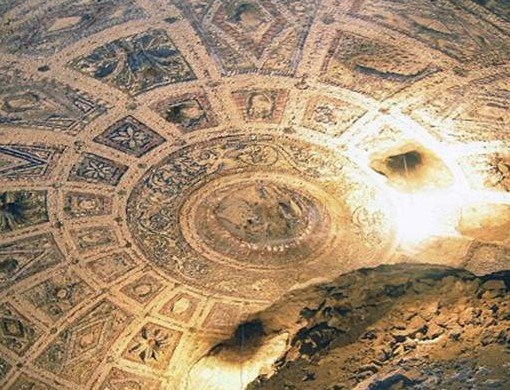
A recent archaeological dig on the Palatine, a hill where the luxurious palaces and villas of the Caesars and other affluent Roman citizens once stood, has uncovered a richly decorated cavern. The cavern in question lies beneath the palace of Augustus, Rome’s first Emperor. He lived from 63 BC to 14 AD and is mentioned in Luke 2:1with the famous words, “In those days a decree went out from Caesar Augustus that all the world should be enrolled.” I expect we’ve all heard that a time or two while attending Christmas services.

This chamber lies roughly 50 feet beneath the surface. While there have been rumors that it is the Lupercale, the room where Romulus and Remus were nursed and the Romans held annual celebrations in honor of the legendary founders of Rome, most people believe it to be a private dining room. The 125 sq. ft. grotto is circular in design and adequate to comfortably house a triclinium, three Roman dining couches arrange in a U-shaped pattern.
Boring in Through the Ceiling
No one has entered the area since the cave is close to collapse. Instead, they drilled a hole through the ceiling and inserted a light and remote camera to see what was there. What they found was a ceiling encrusted with seashells, marble and mosaics. The walls have rectangular panels filled geometric shapes and flowers. The floor, which is not in good shape, also has elaborate mosaics.
Ceiling Decorations

COOL DINING IN THE SUMMER’S HEAT
It is well known that many Roman Emperors, including Nero and Caligula, had small dining rooms built into the natural hollows in the rock underneath their multi-storied palaces. If you’ve ever lived in home with a basement, you know that the temperature remains very comfortable even on the hottest of days. It’s not hard to imagine old Augustus slipping away on a hot night and descending a stairway to his private retreat where he could recline in comfort and dine on delicacies.
Remnants of the Mosaic Floor
So are we looking at the spot where the great emperor feasted with a small circle of friends on roasted peacock tongues seasoned with fermented fish sauce? We very well could be. One wall of the room displays a white eagle, the symbol of the Roman Empire during the reign of Augustus.
Until next time, we wish you Peace and Blessings.
If you reached this post via a link, click the HOME tab above to see other recent posts and visit our archives.

Tuesday, May 29, 2012

THE PYRAMIDS OF NUBIA


Hello My Friend and Welcome. 

Technically, a pyramid is geometric solid with a square base and four isosceles (equal–sided) triangles forming its sides. But to most people a pyramid is any structure that is more or less shaped like a triangle.  

Say the word pyramid, and people immediately think Egypt. But they do exist in other places. An example is the Transamerica Building in downtown San Francisco. Even though it is technically not a pyramid, everyone calls it the Transamerica Pyramid. By this definition, the Assyrian Ziggurats are a type of pyramid as well as the Mayan temples of Central America. The last Egyptian pyramid was built in Abydos by the first king of the Eighteenth Dynasty, Ahmose I, who ruled from 1549-1524 BC. Remember that date; it’s going to become important. 

NOT THE ONLY PYRAMIDS
Interestingly enough, there are other pyramids — real pyramids, not just pointy structures —  on the African continent. As a matter of fact, the ancient kingdom Nubia (now known as The Sudan) had twice as many pyramids as Egypt. And you’ve probably never even heard of them until now. 

It was the Greek philosopher Strabo who, after meeting members of the Nabo tribe in the First Century, dubbed their land Nubia. A thousand years before Strabo was born, the Egyptians had called it Ta-Seti, or the Land of the Bow. In the Old Testament it is known as Kush and the only pyramid builder the Bible mentions is King Taharqa, who ruled from 690 – 664 BC. Let’s revisit those dates. Why did the Nubians…Ta-Setis…Kushites…whatever, begin building pyramids eight centuries after the Egyptians abandoned the practice? 

The answer lies in the historic relationship between the two regions. For over a thousand years the Egyptians dominated Nubia. The frescoes showing the Nubians bringing tribute to the Pharaohs depict them as darker and with curly hair. This was clearly intended to show that the Egyptians were different from, and therefore superior to, the Nubians.  

Frescoe of Nubians Bringing Tribute

But over time Egypt declined and Nubia eventually broke free. However, after thousands of years of commerce and interchange, the Nubians worshipped the same gods and shared the same culture. In 722 BC, when Egypt was at its weakest, the Nubian King, Piye, marched north and conquered his ancestor’s former masters. Rather than seeing themselves as outsiders, he and his successors called themselves Pharaohs and established Egypt’s 25th Dynasty.  

ELABORATE TOMBSTONES
Yet when Piye died, he was returned to Nubia for burial and above his grave there was…you guessed it…a pyramid! Clearly these rulers saw themselves as cut from the same cloth as Egypt’s great rulers. Rulers who, as a testimony to their power, had been buried within pyramids. 

This is where we encounter another Nubian quirk. Their pyramids were not tombs. This confused grave robbers and archaeologists alike until it was discovered that the Nubians cut their burial chambers in to the bedrock. The stairway leading to the burial chamber would be filled in after burial and the pyramid constructed on top. In order to accomplish this, the deceased successors would have to have constructed the pyramid. In effect the pyramids were nothing more than an elaborate tombstone.


This practice continued for 300 years. Eventually the Assyrians drove the Nubian ruler out of Egypt and the Nubians were forced into a long retreat into the southern reaches of their homeland.  They began building pyramids in an isolated area called Meroe around 270 BC and, out of contact with Egypt and the rest of the world, continued for hundreds of years.

Christianity eventually reached the kingdom of Meroe and sometime around 350 AD a king of Meroe built the last pyramid ever constructed on the African continent.

Queen Amanishaketo"s Gold & Jeweled Bracelet

GOING TOPLESS IN THE DESERT
You can thank treasure hunter Guiseppe Ferlini for the deteriorated condition of the Nubian pyramids. He obtained permission to explore and excavate in 1934 from the governor of Khartoum. After fighting off lions, he arrived at Meroe and struck gold, the jewels of Queen Amanishaketo who ruled around the time of the birth of Christ. Rather than admit that he had discovered her underground burial chamber, he said he found the jewelry in a chamber at the top of the pyramid. When word spread, other treasure-hunters flocked to the area and began tearing open the tops of the pyramids searching for treasure that wasn’t there. The end result was lots of damaged pyramids. 


On Friday, we’ll be examining the ancient game known as Tabula. 

Until then, we wish you Peace and Blessings. 

If you reached this post via a link, click the HOME tab above to see other recent posts and visit our archives.

Friday, January 27, 2012

WADI SIKAIT - ROME'S EMERALD CITY

Dorothy and Her Friends Head Off to the Emerald City
Hello My Friend and Welcome.

 
Some of our favorite posts are those that range widely, connecting seemingly unrelated places and events in a memorable way. Hopefully, today’s qualifies. In a moment you’ll understand why we chose the image of Dorothy and her friends skipping along the Yellow Brick Road on their way to the Emerald City to meet the Wizard of Oz.


The Carolina Emperor
FINDING THE CAROLINA EMPEROR
But first, let’s examine the impetus for today’s post…a recent news article about an exceptional 65 carat emerald that was found near a cornfield in North Carolina. They’re calling it the Carolina Emperor. It compares in size and quality to one surrounded by diamonds in a brooch once owned by Catherine the Great that Christie's auction house in New York sold for $1.65 million. And to think that the man’s father used to charge people $3.00 a day to dig around and see what they could find. Bet he’s glad no one stumbled upon this whopper.
Roman Woman Wearing an Emerald Necklace

ROMAN WOMEN FAVORED SMARAGDI
Now it just so happens that among precious stones, emeralds ranked very high on the Roman’s popularity chart. Today, the world’s best quality emeralds are found in Columbia. Emeralds are also mined in Afghanistan, Australia, Brazil, India, Madagascar, Pakistan, Russia, South Africa, Zambia, Zimbabwe and, of course, in North Carolina. A quick review of that list pretty much eliminates the Roman Empire. North and South America, Madagascar and Australia were unknown to the Romans. Rome’s power extended into the northern regions of Africa, but the nations mentioned in the list are all in the extreme south. Rome traded with modern India, but primarily for spices, not gemstones.

So how did that the Romans satisfy their desire for emeralds? Instead of a yellow brick road to Oz, let’s follow a sandy trail across the trackless desert wastes of Eastern Egypt to the ancient region of Wadi Sikait, Rome’s Emerald City, or Mons Smaragdus—Emerald Mountain. The first thing we see from the map is Wadi Sikait’s close proximity to the port city of Berenike. As we learned in a recent post on Foods of the First Century, Berenike was a major debarkation point for Indian spices coming into the Roman Empire, especially pepper. Jute bags of peppercorns along with emeralds traveled from this Red Sea port overland by camel caravan to the Nile, then by boat to Alexandria, and from there to Rome via merchant ship. If you missed the one on Spices & Herbs you can find HERE.


Pliny the Elder, in his Natural History, addresses the legend, lore and gossip of emeralds, which the Romans called smaragdi. Referencing gems from the Eastern Desert, which he calls them Egyptian or Ethiopian stones, he says they were “so hard as to be unaffected by blows.” Romans valued emeralds above all gems except diamonds and pearls. Pliny also writes, “I have seen Lollia Paulina, who became the consort of Gaius (we know him as Caligula) covered with emeralds and pearls interlaced and shining over her head, hair, ears, neck and fingers, the sum total amounting to a value of 40,000,000 sesterces.” Quite an image, isn’t it? To put this into better perspective, recall that a soldier’s annual wage at that time was around 1,200 sesterces.

DO IT YOURSELF EMERALDS
Like anything of high value, unscrupulous merchants attempted to counterfeit emeralds. Pliny denounced the practice and told how, “There are treatises by authorities describing how, by means of dyestuffs, emeralds and other transparent colored gems are made from rock crystal… And there is no other trickery practiced against society with greater profit.” Some things apparently never change. It is standard practice today to oil emeralds to disguise their flaws.

 
LOST FOR OVER A THOUSAND YEARS
Wadi Sikait was the sole source of emeralds for the Romans. The area flourished, which explains why the Romans called the region Emerald Mountain. Unbelievably, the location of the site was eventually lost. In 1816, Mohammed Ali Pasha, the Ottoman Viceroy to Egypt, set out to find the fabled lost emerald mines of the Romans. He sent Fédéric into the desert to find them. It took him three years, but in 1817 Cailliaud re-discovered the mines.

In his journals Cailliaud spoke of finding a site that contained a beehive like structure consisting of “perhaps a thousand excavations” with long underground causeways interconnecting them to facilitate communication. They were built in such a way that camels could move through the passageways bringing the workmen provisions. He marveled at the labor it would have taken to construct such a complex.

Unable to explore the mines himself, he continued on and three-and-a-half miles from there discovered an abandoned town. The Bedouins of the area called the place Sekket (Sikait) Bendar El Kebyr. He found 500 houses hewn from the native stone and three temples cut into the sides of the mountains. He spoke of wandering the deserted dwellings and finding “various instruments, utensils…fired clay lamps.” He found fragments of vases “of beautiful form” made of both bisque and glass. Cailliaud discovered stone grinding mills still waiting for grain…an entire town “hitherto unknown to all voyagers, which had not been inhabited, perhaps, for 2,000 years and almost entirely standing.
In fact, the area had been abandoned only about 1,300 years. Roman mining ceased there somewhere around the year 500 …a date that coincides nicely with Edward Gibbons date of 476 for the Fall of The Roman Empire.

 
NO LONGER ECONOMICALLY FEASIBILE
Despite Cailliaud success in finding the ancient site, the mines were never re-opened. The heat and the terrain proved too severe and the stones then being mined in South America were superior to those available at Wadi Sikait. One reason for the lower quality could be that the best stones were already removed during Roman times. The Roman writer Strabo, when writing his Geography in the First Century, states that the Arabs dug ever deeper tunnels in their quest to extract emeralds.

One of Cailliaud's Drawings
Cailliaud made several pen and ink drawings of the temples he discovered. Based on current photos of the same buildings, there has either been a lot of destruction during the intervening years or, more likely, his depictions present a fanciful image of how the buildings appeared during Wadi Sikait’s heyday. Note the rather significant differences between current reality and his drawing of the temple façade in the photo below.


WADI SIKAIT AND PETRA
Seeing Wadi Sikait immediately brought Petra to my mind. Petra, the ancient city of rock, is in a much better state of preservation, but anyone familiar with this former capital of the Nabateans can’t help but be reminded of it when viewing Cailliaud’s drawings. Located in what is now the country of Jordan, Petra predates Wadi Sikait by six centuries. 

Like Petra, Wadi Sikait, was a city in the desert. Also like Petra, its principal structures are carved out of the rock face with the interior of the buildings cut into the mountainside. This method of construction was undoubtedly used to combat the temperature extremes of a desert environment. 
SURVIVAL IN THE HARSH CLIMATE
Archaeological expeditions in the last fifteen years have found the remains of many of the mines around Mons Smaragdus. Still, the area elicits more questions than answers. Working conditions must have been, to say the least, brutal. Winter temperatures range into the 90’s, sometimes higher, and can drop into the 30’s at night.  Archaeologists also report that there were days when their thermometers didn’t go high enough to register the afternoon temperatures.

How the people survived day-to-day remains unclear. Researchers have found several ancient wells, but whether they produced sufficient water is impossible to say. There is some evidence that fruit and vegetables were grown on site, but wine, oil, meat (did it come on the hoof or dried and salted?) and fish would have to have been brought in. Other excavations have found evidence that transport animals, especially donkeys, were slaughtered for food. Was that part of an overall plan or does it indicate periods of scarcity?

Experts also do not know if emeralds were mined before control of Egypt passed into Roman hands in 30 BC. Study of potsherds, however, suggests that Wadi Sikait’s history dates back to the First Century…shortly after Egypt became a Roman Province.
Next time we’ll look at Rome’s Flavian Amphitheatre…more commonly called the Coliseum.
Until then, we wish you Peace and Blessings.
If you reached this post via a link, click the HOME tab above to see other posts and our archives.

Sunday, October 16, 2011

THE DEAD SEA SCROLLS - DIGITIZED


Hello My Friend and Welcome:

Unquestionably the greatest archaelogical discovery of the Twentieth Century was the Dead Sea Scrolls in the caves of Qumran. After the New Year, we plan to do a series of posts about the Scrolls...why and how they were preserved, what they've taught us, the community that created them and so on. However, there is on very exciting development that I want to share with you today.
In an announcement timed to co-incide with Rash HaShanah, the Jewish New Year, the world was told that through a co-operative effort of Google and the Jewish Museum devoted to the Dead Sea Scrolls they have been made  available on-line. That's right. You can now examine digital copies of the scrolls on-line at your convenience. Click below to see a video about the site.


We'll have lots of additional information about the Scrolls and the insights they provide into the Bible and the Early Church after the First of the Year. In the meantime, I encourage you to visit the site and look it over. You can access the Dead Sea Scroll site AT http://dss.collections.imj.org.il/

Until next time, We wish you Peace and Blessings.